Quick answer
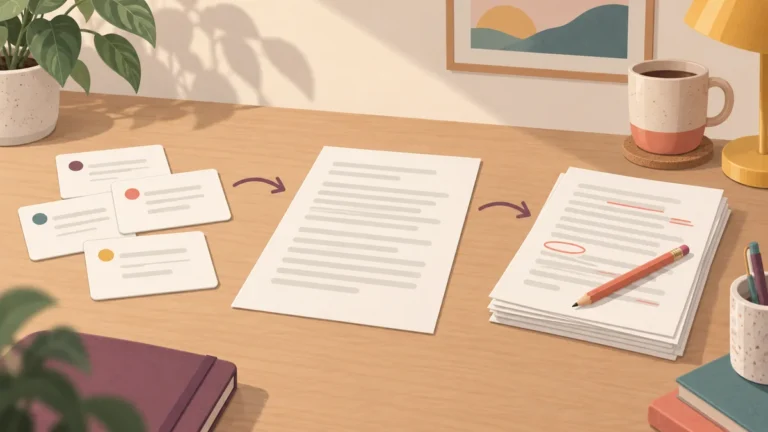
Before you read, choose a small stopping point and one question the section should answer. Read with a pencil or notes page nearby, pause after a paragraph or page to recall the main idea, and use a simple return cue when you notice your mind has wandered. Do not punish yourself by restarting the entire chapter.
Mind wandering is a signal, not a verdict
You can look at every word on a page and realize that none of it stayed with you. Research reviews generally find a negative relationship between mind wandering and reading comprehension, but the size of the effect varies across tasks and people. The practical lesson is modest: notice the drift earlier and make the reading more active.
Give the reading a job
“Read chapter six” is broad. A question gives your attention something specific to collect.
- What problem is this section explaining?
- What are the three steps in this process?
- Which example best supports the author’s claim?
- What would I need to explain to someone else?
Write the question at the top of the page. You are not trying to remember every sentence; you are looking for an answer.
Choose a visible stopping point
Use a heading, two pages, or one short section instead of an open-ended promise to “keep reading.” When the material is dense, make the first target deliberately small.
A ten- or fifteen-minute session can be enough to enter the text. If the session gains momentum, continue. If it does not, you still completed a defined piece. The 15/5 and 25/5 options are useful starting points.
Read, close, recall
- Look away from the page.
- Say or write the main idea in one sentence.
- Note one detail that supports it.
- Reopen the text to check what you missed.
This keeps reading from becoming only eye movement. Your note can be rough. Its purpose is to show whether the idea reached you.
Use a return cue
- Mark: place a dot beside the last line you remember.
- Name: quietly say, “I drifted.”
- Return: reread only from the dot and answer your current question.
The cue should be neutral and quick. A long argument with yourself becomes a second distraction. If the same thought keeps returning, write a few words on a “later” list, then go back to the page.
Adjust the environment before blaming effort
- Move the phone out of reach or into another room.
- Close unrelated tabs.
- Reduce nearby conversation when possible.
- Use a blank sheet to cover the part of the page you are not reading.
- Keep only the book and your question visible.
For sound, silence is a useful baseline. The evidence on background sound is mixed, and intelligible speech can interfere with reading. The sound comparison guide offers a short way to compare silence, rain, and steady noise without assuming one is best for everyone.
Match the strategy to the reason
If you drift because the text is confusing, slow down and define unfamiliar terms. If the section feels too easy, turn headings into questions and predict the answer. If you are exhausted, a short reset or sleep may be more useful than repeating the same page.
Persistent difficulty with reading or attention can have many causes. This guide is not a diagnosis. A teacher, learning specialist, or qualified professional can help when the problem frequently affects school or daily life.
Try one section now
Choose one heading and write one question. Read until the next heading, close the page, and answer from memory. You can open MinuFlow for one short session and leave the next question ready for your return.
Sources and notes
- Faber et al., “The relationship between mind wandering and reading comprehension: A meta-analysis”: PubMed record and full text.
- Feng et al., “Mind wandering while reading easy and difficult texts”: PubMed record.
- Vasilev et al., “Auditory Distraction During Reading”: full text.
- Editorial boundary: this article offers general strategies and does not diagnose or treat an attention, learning, or health condition.