Quick answer
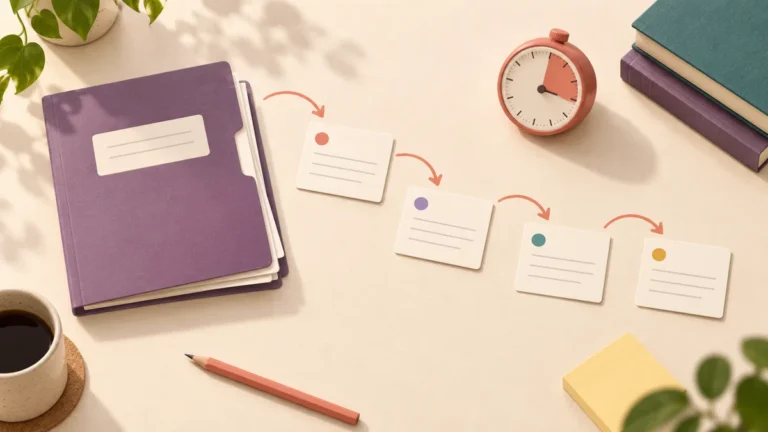
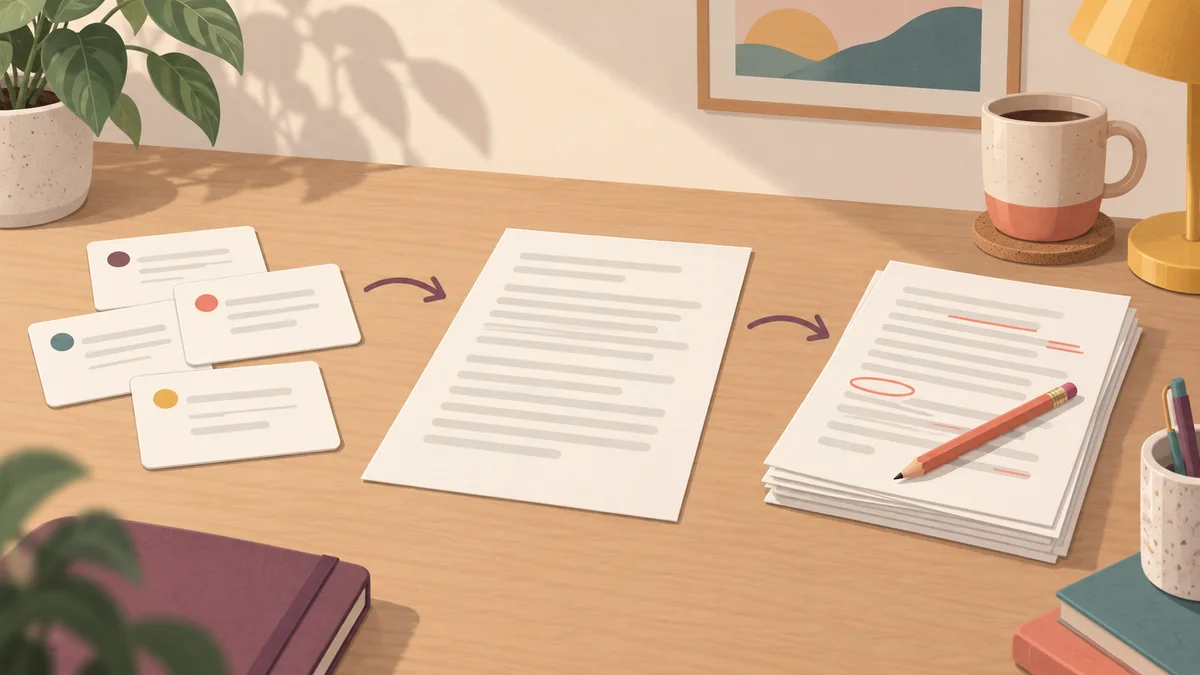
Separate the essay into three modes: plan, draft, and revise. Give each focus session one visible outcome, such as a working claim, one body paragraph, or a structural revision. While drafting, leave placeholders for details that would pull you into research. Revise after you have enough words to work with.
Stop asking one session to do three jobs
Essay writing becomes slow when you try to invent ideas, perfect sentences, verify every detail, and format citations at the same time. These activities require different kinds of attention.
- Plan: decide the response and the order of ideas.
- Draft: turn the plan into complete but imperfect sentences.
- Revise: improve the argument, organization, evidence, and wording.
Purdue OWL distinguishes revising from editing and recommends creating distance from a draft when time allows. Treating them as separate stages gives each session a clearer target.
Plan with a sentence-level map
Before writing the introduction, complete these lines:
- My answer to the prompt is…
- The reader needs to understand…
- My strongest example is…
- The main sections should appear in this order because…
Then give each body section a temporary heading. The headings do not need to appear in the final essay. They are rails for the draft.
If the assignment still feels too large, use the assignment-session guide to turn the deliverables into smaller actions.
Draft forward with placeholders
During a drafting session, do not open a new search every time you need a date, quotation, or citation format. Mark the gap clearly:
[add source for this claim][check date][explain why this example matters]
Then keep moving. Return to the placeholders in a research or revision session. This protects the current line of thought without hiding unfinished work.
Give each session one outcome
- Session 1: working claim and section order.
- Session 2: first body paragraph.
- Session 3: second body paragraph.
- Session 4: introduction and conclusion.
- Session 5: evidence and citation gaps.
- Session 6: structural revision.
- Session 7: sentence editing and final requirements.
Your timer is a boundary, not the goal. If a paragraph needs another five minutes, finish the thought. If you stop midsection, leave a return cue describing the next sentence.
Revise from large to small
- Does the essay answer the prompt?
- Is the main claim clear and supportable?
- Does each paragraph have one purpose?
- Is the evidence explained, not merely inserted?
- Would a different order make the reasoning easier to follow?
Only then edit sentence flow, punctuation, and formatting. Polishing a paragraph that may be removed is expensive attention.
Keep a distraction capture list
Place a small sheet beside the draft. When an unrelated task appears—send an email, check a definition, look up another source—write it down without following it.
If switching tabs is the recurring problem, the one-task guide gives you a simple parking place for those urges.
When you feel stuck
Lower the standard for the next five minutes. Write: What I am trying to say is… Explain the idea in plain language. You can revise the wording later. A rough sentence gives you material; an empty page gives revision nothing to work with.
Start with the body
You do not have to begin with the introduction. Choose the section you understand best, set one short session, and draft it in ordinary language. Then open MinuFlow and leave one clear return cue when the session ends.
Sources and notes
- Purdue Online Writing Lab, “Steps for Revising”: Purdue OWL guidance.
- Purdue Writing Lab, “Preparing to Revise and Edit a First Draft”: revision guide.
- Editorial boundary: follow the assignment prompt, rubric, citation rules, and your institution’s academic-integrity policy.