Quick answer
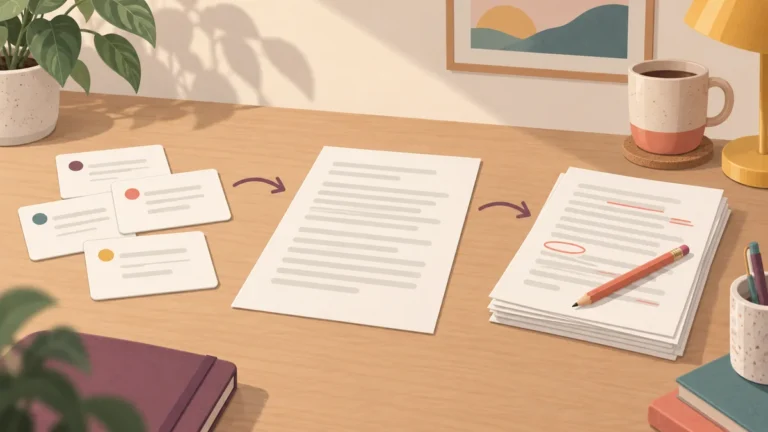
Start with the finished assignment, then work backward. List the few deliverables it needs, turn each deliverable into a physical next action, and give one action to each focus session. A session should end with something visible: three sources saved, one section outlined, or one paragraph revised. You do not need to plan every minute before you begin.
Why “work on the assignment” is too vague
A large assignment can hide several different kinds of work: understanding the prompt, finding sources, deciding what you think, drafting, checking requirements, and revising. When all of that sits under one task name, starting requires too many decisions at once.
Instead of writing “research paper” on your list, name the next thing your hands can do. Washington University’s Learning Center recommends breaking large assignments into smaller segments and setting deadlines for them. An open student-success text makes the same idea concrete: create chunks that can fit into a single work period.
Step 1: define what “done” includes
Read the prompt once and list the final pieces. For an essay, that might be:
- a clear response to the question;
- evidence from four sources;
- a draft with an introduction, body, and conclusion;
- citations in the required format; and
- a final check against the rubric.
This is not yet your session plan. It is the map that keeps a missing requirement from surprising you later.
Step 2: turn each piece into a next action
A useful next action begins with a verb and produces an observable result.
- Research: Save three credible sources and write one sentence about each.
- Start essay: Draft a working claim and three section headings.
- Work on slides: Build the title slide and the first content slide.
- Revise: Read the first two pages for structure and move any misplaced paragraph.
If an action still feels heavy, divide it again. “Find three sources” can become “search the library database with two keywords and open five possible results.”
Step 3: give one outcome to each focus session
Choose a session length you can honestly complete. The outcome matters more than matching a perfect timer formula.
- Session 1: decode the prompt and list requirements.
- Session 2: collect three possible sources.
- Session 3: write a rough claim and outline.
- Session 4: draft the first body section.
- Session 5: draft the next section.
- Session 6: revise the structure.
- Session 7: check citations and the rubric.
Use the focus-rhythm guide to choose between a shorter start and a longer work block. Treat the rhythm as a starting setting, not a promise about productivity.
Step 4: leave a return cue
At the end of each session, write one line:
Next: compare sources two and three, then choose the stronger example.
This removes a decision from your next start. It also lets you stop without needing to finish the entire assignment in one sitting.
If you are tempted to jump between sections, use the one-task guide and keep a small “later” list beside the current action.
A simple assignment board
Use three columns on paper or in a notes app:
- Next: actions ready to begin;
- Working: the single action for this session; and
- Done: visible outcomes you have completed.
Keep only one item in Working. When the session ends, move it to Done or rewrite the unfinished part as a smaller next action.
If the deadline is close
- Meet the core requirements.
- Create a complete rough version.
- Repair the largest gaps.
- Polish only after the assignment is structurally complete.
If starting is the main obstacle, try the 20-minute study reset. Open the material, choose one visible outcome, and begin before extending the plan.
Begin with one card
Write the assignment name at the top of a page. Under it, list the final deliverables and circle the smallest useful action. Then open MinuFlow and give that action one focus session.
The goal is not to make the assignment feel tiny. It is to make the next move clear.
Sources and notes
- Washington University in St. Louis, “Time Management & Productivity Strategies”: Learning Center guidance.
- College Success, “Develop an Assignment Plan”: open textbook chapter.
- Editorial boundary: this is general planning guidance. Course requirements and instructor directions remain the authority for a specific assignment.