Quick answer
Give yourself a short transition after school, then begin with a small task that has a clear finish. Match the task to your energy: organize or review when you are drained, and save harder problem-solving for the strongest available window. Use one short focus session before deciding whether to continue, and do not make late-night studying the default replacement for sleep.
Build a bridge between school and study
Going directly from a full school day into demanding homework can feel like asking your attention to change gears without slowing down.
Create a 15- to 30-minute transition with a defined end. It might include:
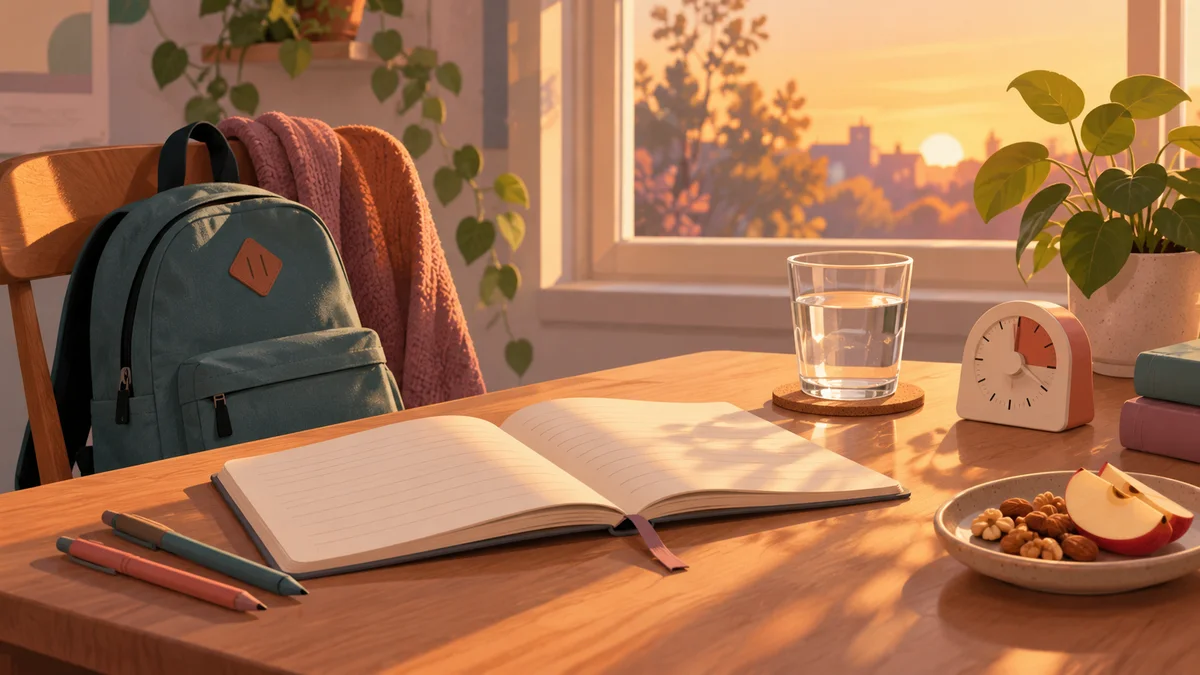
- putting your bag in the study area;
- having water and a normal snack;
- changing clothes;
- taking a short walk or screen-free rest; and
- choosing the first task before the break ends.
Avoid a transition with no stopping point. “I will scroll until I feel ready” can make the start less visible.
Check what kind of low energy you have
- Am I physically sleepy, or mainly resistant to a difficult task?
- Is there a deadline tonight, or can the hardest work move to a better window?
If you are repeatedly very sleepy, struggling to stay awake, or concerned about your health, talk with a parent, guardian, school professional, or qualified health professional. A productivity technique is not a substitute for sleep or care.
Choose a low-friction first task
- Open the assignment and list its requirements.
- Organize the materials for one subject.
- Review five flashcards.
- Correct two practice problems.
- Read one short section.
- Write the first line of an outline.
The first task should create direction, not become an hour of “getting ready.” After it, move to the highest-priority action you can reasonably complete.
If a large assignment is the problem, break it into focus sessions before starting.
Use a minimum viable session
Pick one outcome for 10, 15, or 20 minutes. For example:
For 15 minutes, I will solve the first three problems and mark where I get stuck.
At the end, choose deliberately: continue for another session, switch to a lighter task, or stop and schedule the next action. The stop point is real.
Match work to the energy curve
- Low energy: organize, preview, correct, make questions, gather materials.
- Medium energy: routine practice, review, short reading, straightforward drafting.
- Higher energy: new concepts, difficult problems, important revision.
You cannot always wait for high energy, but you can avoid spending your best available window on formatting or file organization.
Protect sleep from the catch-up loop
CDC guidance says students ages 13–18 generally need 8–10 hours of sleep per 24 hours, and school-age children 6–12 need 9–12 hours. Sleep needs vary, but regularly trading sleep for late-night work can make the next afternoon harder.
If tonight’s plan is too large, protect the essential requirements, prepare a specific question for your teacher, and make tomorrow’s first action visible. For an upcoming exam, the low-pressure seven-day plan spreads practice across the week.
Create a repeatable arrival cue
- Place the phone away from the workspace.
- Get water and the needed material.
- Write the first outcome.
- Start one short timer.
- Leave a return cue before stopping.
On difficult days, completing the sequence is useful progress. Open MinuFlow for one realistic session, then decide what the next part of the afternoon needs.
Sources and notes
- Centers for Disease Control and Prevention, “Sleep and Health”: CDC student guidance.
- Centers for Disease Control and Prevention, “About Sleep”: CDC sleep guidance.
- Editorial boundary: this is general educational guidance, not medical advice. Persistent fatigue, sleep difficulty, or changes in functioning deserve support from a qualified professional.