Quick answer
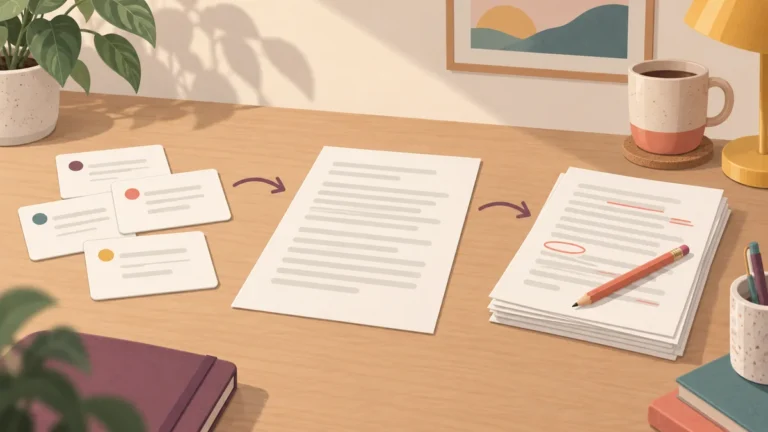
With one week left, divide the material into small groups and practice bringing information to mind instead of only rereading it. Review difficult topics again on later days, use short timed sessions, and make the final evening lighter. Protect sleep. The goal is a workable sequence you can repeat, not seven days of maximum intensity.
Seven-day overview: map → retrieve → revisit → mix → practice → repair → lighten.
First, reduce the number of decisions
The week before an exam can feel like one large unfinished task. Turn it into a short list you can see.
On one page, write:
- the topics the exam covers;
- the question types you expect;
- the topics you can explain without notes;
- the topics that still break down; and
- any fixed commitments during the week.
Do not build a minute-by-minute schedule. Choose one or two useful outcomes for each day and leave space for correction.
Why retrieval and spacing belong in the plan
Retrieval practice means trying to bring information to mind before looking at the answer. Examples include answering a practice question, explaining a concept from memory, or writing the steps of a process on blank paper.
A broad research literature supports retrieval practice for later learning. A classroom meta-analysis and a systematic review in health-professions education found benefits from practice testing, distributed practice, retrieval practice, or combinations of them across varied settings. The studies differed in design and setting, so the finding is a principle to adapt rather than a guaranteed score increase.
Use rereading to repair a gap after you find it. Do not make rereading the only way you study.
A calm seven-day plan
Day 7 — map the exam
Collect the syllabus, study guide, practice questions and your notes. Make the one-page topic list. Then do a short closed-notes check:
- What can I already explain?
- What do I recognize but cannot produce?
- What is still unfamiliar?
Mark only three priority areas. A complete inventory is more useful than an ambitious first day.
Day 6 — retrieve the first priority
Choose the first priority area and answer questions without notes. If no practice questions exist, turn headings into prompts.
For example:
Instead of rereading “Stages of mitosis,” close the page and write the stages in order with one event from each stage.
Check your answer, correct it, and save the missed part for another day.
Day 5 — retrieve the second priority and revisit the first
Begin with a brief return to yesterday’s difficult points. Then move to the second priority area.
This creates spacing: the first topic reappears after time has passed rather than staying in one long block.
Day 4 — mix question types
Practice several topics in one session. Mix definitions, worked problems, comparisons and short explanations where the exam requires them.
Keep a small error log with two columns:
| I missed | Next action |
|---|---|
| Chose the wrong formula | Do two problems that require choosing the formula |
| Forgot the second cause | Explain all three causes without notes tomorrow |
The log is a map for the next session, not a record of failure.
Day 3 — practice under light constraints
Try a short set with the notes closed and a reasonable time limit. Use conditions similar to the exam where practical, but keep the set small enough to review carefully.
Afterward, sort mistakes into:
- knowledge gap;
- misunderstood question;
- rushed step; or
- correct idea, incomplete answer.
Repair the cause rather than repeating the whole chapter.
Day 2 — revisit the error log
Attempt the missed items again before reading the corrections. Explain the hardest two topics aloud or on blank paper.
If a topic still does not make sense after focused review, ask a teacher, classmate or tutor a specific question. “Can you show me why step three uses this formula?” is easier to answer than “I do not understand the unit.”
Day 1 — lighten the load
Use a short final check for the highest-value material. Pack what you need, confirm the exam time and location, and stop adding new resources late in the evening.
CDC student guidance notes that insufficient sleep can make concentrating harder, while sufficient sleep supports attention and readiness to learn. A late cramming session that removes sleep can work against the task you are preparing for.
The final evening is for orientation and confidence, not rebuilding the entire course.
Choose a session length that keeps you returning
Use a session you can complete honestly. A 15/5 or 25/5 rhythm can lower the barrier to starting. A 52/17 or 90/20 rhythm may suit work that already has momentum. These are adjustable starting points, not performance formulas.
The focus-rhythm comparison can help you choose. If you are stuck before the first session, use the 20-minute study reset or try five small changes when studying keeps losing the thread.
If the plan slips
Do not compress three missed days into one punishing schedule. Restart with this order:
- Identify the highest-value topics.
- Retrieve before rereading.
- Review errors.
- Protect the final sleep window.
Even one specific practice set is more useful than spending the remaining time redesigning the plan.
Begin with ten minutes
Write the topic list and attempt one short memory check today. You can open the MinuFlow focus space and choose a session that feels small enough to begin.
At the end, write the next question you will answer tomorrow. That single line makes the return easier.
Sources and notes
- McDermott, “Practicing Retrieval Facilitates Learning,” Annual Review of Psychology (2021): PubMed record.
- Trumble et al., “Systematic review of distributed practice and retrieval practice in health professions education,” Advances in Health Sciences Education (2024): PubMed record.
- Binks, “Testing enhances learning: A review of the literature,” Journal of Professional Nursing (2018): PubMed record.
- Yang et al., “Testing (quizzing) boosts classroom learning: A systematic and meta-analytic review,” Psychological Bulletin (2021): PubMed record.
- Centers for Disease Control and Prevention, “Sleep,” Youth Health in Focus (2026): CDC guidance.
- Editorial boundary: this is a general study-planning guide. It does not guarantee an academic result and does not replace accommodations, instruction or professional support.