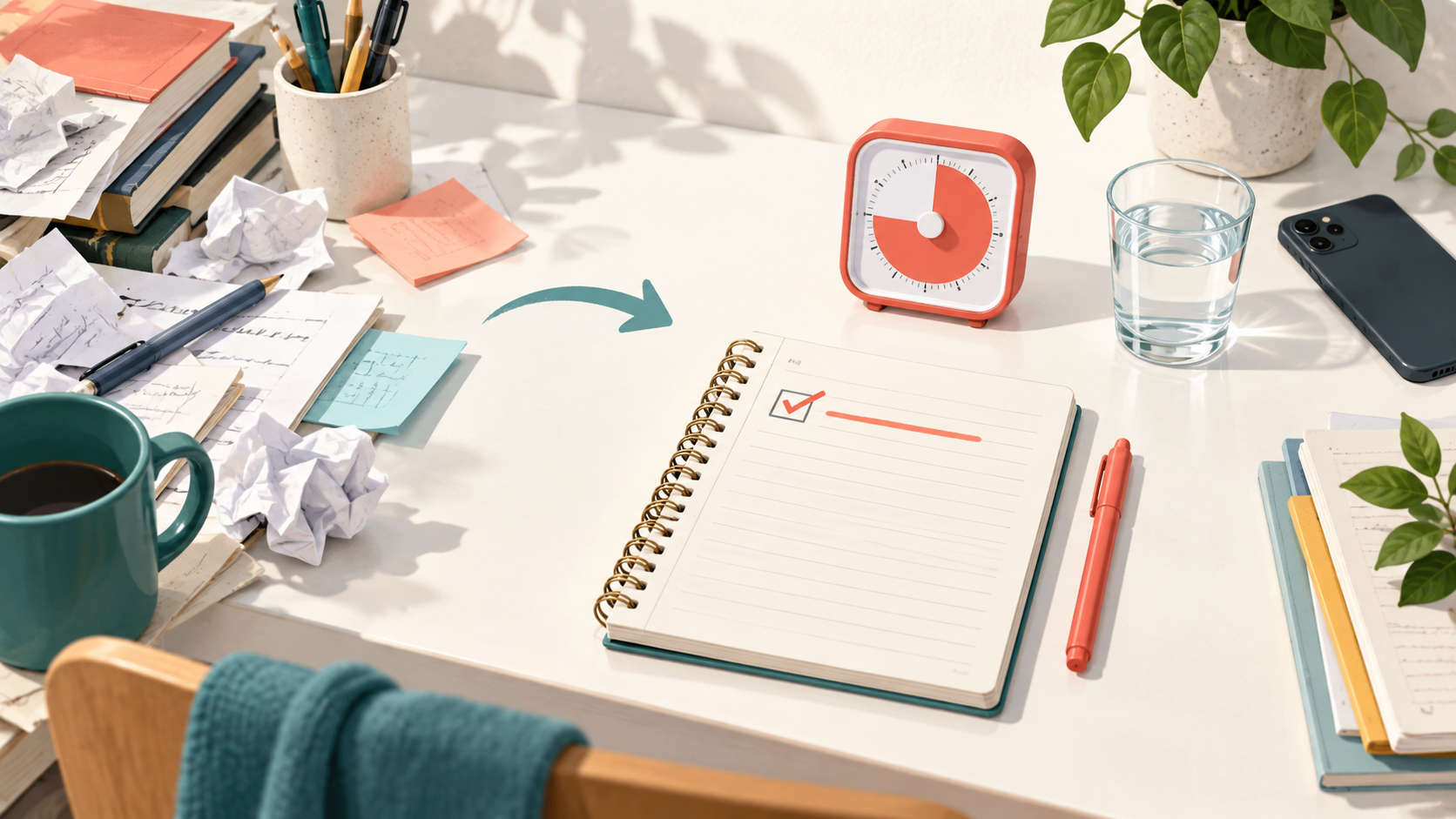
Studying with ADHD can feel inconsistent. You may care about the work and understand its importance, yet still have trouble starting, organizing the steps, estimating time, or returning after an interruption. That difficulty is not proof that you are lazy or that you do not want the result.
This article offers a gentle routine for creating external structure around a study session. It is educational, not medical advice, and it is not a substitute for an individual assessment or treatment plan. Attention difficulties can have many causes, and having trouble focusing does not by itself mean that someone has ADHD.
What ADHD can affect during studying
ADHD is a developmental disorder involving ongoing patterns of inattention, hyperactivity, and/or impulsivity that interfere with functioning. Experiences differ from person to person. According to the National Institute of Mental Health, adults and young people may have difficulties with organization, sustained attention, remembering daily tasks, or managing distractions, among other symptoms.
A study plan can help create cues and boundaries, but it does not diagnose or treat ADHD. If attention difficulties are persistent and affecting school, work, relationships, or daily life, a qualified health professional can help assess what is happening.
A low-pressure study routine
The routine below has six parts. Use the pieces that reduce friction for you. The aim is not to control every minute; it is to make the next useful action easier to see.
1. Choose a landing spot
Before choosing the task, decide where this session will happen. Look for a place that is comfortable enough to remain in and simple enough that the work is visible.
- Put only the current subject within reach.
- Move the phone away or use a focus setting that allows essential contacts.
- Open the document, book, or problem set before the timer begins.
- Use headphones, steady sound, or quiet based on what helps this particular task.
- Keep water and any needed supplies nearby.
The best environment is not always silent or perfectly tidy. It is the one with fewer unnecessary decisions between you and the next step.
2. Replace the project with one visible action
Large labels such as “study for finals” or “write my paper” can hide the entry point. Write a target that can be observed.
- Answer questions 1–4 and circle uncertain answers.
- Read two pages and explain each heading in one sentence.
- Find three sources and record their main claims.
- Write a rough paragraph without editing it.
If the action still feels hard to enter, reduce it again. “Open the assignment and highlight the instructions” is a legitimate start.
3. Make time visible
Choose an interval that feels possible today. A timer provides an external boundary, which can be useful when time feels vague or when a task has no obvious stopping point.
- Try 10–15 minutes when activation is the main barrier.
- Try 25 minutes for a short, structured work round.
- Try 40–60 minutes when frequent stops are more distracting than helpful.
- Use a custom interval when standard methods do not match your energy or task.
Do not use a long interval as a punishment for a difficult start. A completed short round can create more useful momentum than an avoided 90-minute plan.
4. Keep a side channel for distractions
Place a blank note beside the work. When an unrelated thought appears, write a few words instead of trying to hold it in memory or acting on it immediately.
Your list might say “email professor,” “buy charger,” or “look up term.” At the break, decide what truly needs attention. This technique does not require the thoughts to disappear; it gives them somewhere to go.
5. Use a break with a return cue
Before leaving the task, write the exact next step: “Continue with question 5,” “check the second citation,” or “rewrite the topic sentence.” Then take the break.
A break can include movement, water, a snack, a bathroom visit, or a change of view. Set a separate break timer if it helps. The return cue reduces the work of reconstructing where you were.
6. End with evidence, not judgment
At the end of the session, record three small facts:
- What moved forward?
- What made starting or continuing easier?
- What should change next time?
“I finished two problems and need a shorter interval after lunch” is more useful than “I was bad at focusing.” Build the next session from what happened, not from what you think should have happened.

When starting feels impossible
Use a five-minute entry instead of waiting for motivation:
- Put the correct material on screen.
- Write the smallest next action.
- Start a five-minute timer.
- Work until it ends.
- Choose deliberately: continue, take a short break, or make the task smaller.
The five-minute entry is not a test. Its value is that it turns an abstract task into direct contact. Even if you stop, you know more about the next obstacle.
Consider external support
Some people find that studying near another person, attending office hours, using academic accommodations, or checking in with a tutor adds helpful structure. Support does not make the work less yours.
If you are a student, your school may have disability, accessibility, counseling, or learning-support services. Requirements and available accommodations vary, so ask the appropriate office about its process.
Sleep, movement, and care still matter
Concentration strategies work inside a larger health picture. The Centers for Disease Control and Prevention describes ADHD care as something that may include behavioral approaches, medication, school support, and healthy habits, depending on a person’s age and needs. Treatment decisions belong with qualified professionals and the individual or family involved.
Try not to use productivity tools to push through every sign of exhaustion. Regular sleep, meals, movement, and recovery can support learning, but no single habit is a cure.
When to seek professional help
Consider talking with a qualified health professional when attention, impulsivity, restlessness, organization, or time-management difficulties are persistent and interfere with daily life. A clinician can consider other possible explanations, understand your history, and discuss appropriate next steps.
If you already have an ADHD diagnosis or treatment plan, use study tools in a way that supports that plan. Bring patterns you notice, such as medication timing, sleep changes, or recurring study barriers, to the professional who knows your care.
Use MinuFlow as a structure, not a score
MinuFlow can make the session and break boundaries visible. Choose Pomodoro, 52/17, 90/20, or a Custom interval, then keep one concrete target in view. The timer is there to support the work, not to measure your worth or replace care.
Choose a focus interval in MinuFlow
Frequently asked questions
Does trouble focusing mean I have ADHD?
No. Many factors can affect concentration, including stress, sleep, mood, environment, health conditions, and medication effects. ADHD diagnosis requires a professional evaluation based on established criteria and a broader history.
Is Pomodoro good for ADHD?
Some people appreciate its short boundary and frequent reset; others find 25 minutes too short or the breaks hard to return from. Try one or two sessions, observe the result, and adjust the interval and break structure.
What if breaks turn into long distractions?
Choose the break activity before starting, use a separate break timer, and leave a written return cue. Consider breaks that do not begin with an open-ended app or feed.
Should I study in silence?
There is no single sound environment that works for everyone or every task. Compare quiet, familiar instrumental audio, steady background sound, or a shared study space against the quality of your actual work.
Sources and further reading
- National Institute of Mental Health: Attention-Deficit/Hyperactivity Disorder — What You Need to Know
- Centers for Disease Control and Prevention: Treatment of ADHD
Last reviewed for source accuracy: September 2026. This article is for general education and does not provide diagnosis or medical advice.