Posted on — Leave a comment

A Low-Pressure Study Plan for the Week Before an Exam

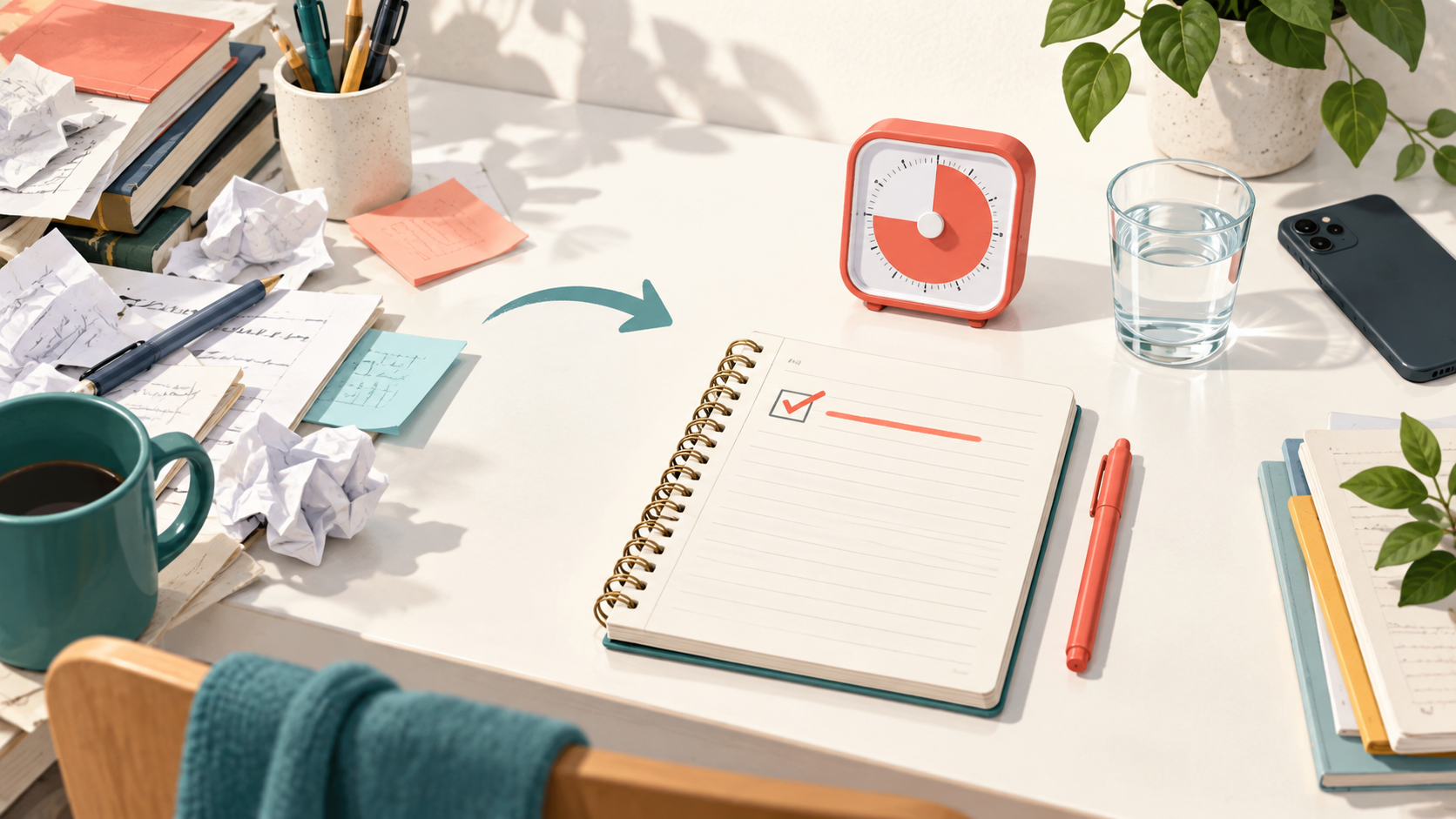
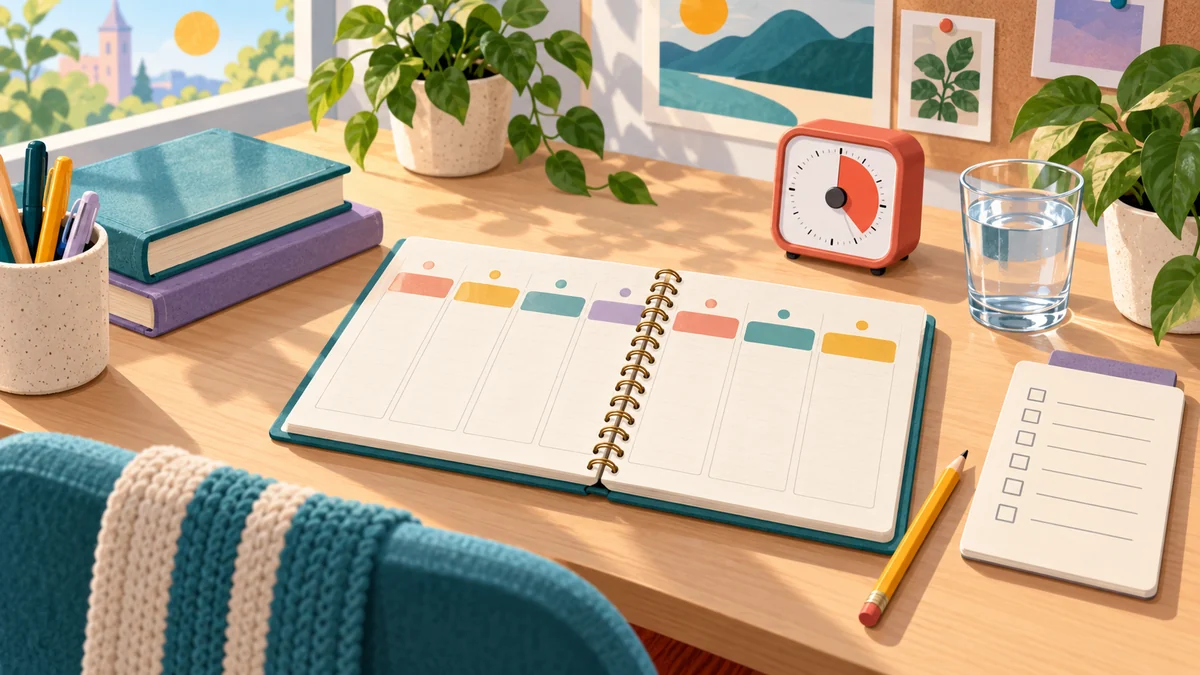
A calm exam-week study desk with a weekly plan, books, a timer, water, and plants

Quick answer

With one week left, divide the material into small groups and practice bringing information to mind instead of only rereading it. Review difficult topics again on later days, use short timed sessions, and make the final evening lighter. Protect sleep. The goal is a workable sequence you can repeat, not seven days of maximum intensity.

Seven-day overview: map → retrieve → revisit → mix → practice → repair → lighten.

First, reduce the number of decisions

The week before an exam can feel like one large unfinished task. Turn it into a short list you can see.

On one page, write:

  • the topics the exam covers;
  • the question types you expect;
  • the topics you can explain without notes;
  • the topics that still break down; and
  • any fixed commitments during the week.

Do not build a minute-by-minute schedule. Choose one or two useful outcomes for each day and leave space for correction.

Why retrieval and spacing belong in the plan

Retrieval practice means trying to bring information to mind before looking at the answer. Examples include answering a practice question, explaining a concept from memory, or writing the steps of a process on blank paper.

A broad research literature supports retrieval practice for later learning. A classroom meta-analysis and a systematic review in health-professions education found benefits from practice testing, distributed practice, retrieval practice, or combinations of them across varied settings. The studies differed in design and setting, so the finding is a principle to adapt rather than a guaranteed score increase.

Use rereading to repair a gap after you find it. Do not make rereading the only way you study.

A calm seven-day plan

Day 7 — map the exam

Collect the syllabus, study guide, practice questions and your notes. Make the one-page topic list. Then do a short closed-notes check:

  • What can I already explain?
  • What do I recognize but cannot produce?
  • What is still unfamiliar?

Mark only three priority areas. A complete inventory is more useful than an ambitious first day.

Day 6 — retrieve the first priority

Choose the first priority area and answer questions without notes. If no practice questions exist, turn headings into prompts.

For example:

Instead of rereading “Stages of mitosis,” close the page and write the stages in order with one event from each stage.

Check your answer, correct it, and save the missed part for another day.

Day 5 — retrieve the second priority and revisit the first

Begin with a brief return to yesterday’s difficult points. Then move to the second priority area.

This creates spacing: the first topic reappears after time has passed rather than staying in one long block.

Day 4 — mix question types

Practice several topics in one session. Mix definitions, worked problems, comparisons and short explanations where the exam requires them.

Keep a small error log with two columns:

Example error log for the next study session
I missed Next action
Chose the wrong formula Do two problems that require choosing the formula
Forgot the second cause Explain all three causes without notes tomorrow

The log is a map for the next session, not a record of failure.

Day 3 — practice under light constraints

Try a short set with the notes closed and a reasonable time limit. Use conditions similar to the exam where practical, but keep the set small enough to review carefully.

Afterward, sort mistakes into:

  • knowledge gap;
  • misunderstood question;
  • rushed step; or
  • correct idea, incomplete answer.

Repair the cause rather than repeating the whole chapter.

Day 2 — revisit the error log

Attempt the missed items again before reading the corrections. Explain the hardest two topics aloud or on blank paper.

If a topic still does not make sense after focused review, ask a teacher, classmate or tutor a specific question. “Can you show me why step three uses this formula?” is easier to answer than “I do not understand the unit.”

Day 1 — lighten the load

Use a short final check for the highest-value material. Pack what you need, confirm the exam time and location, and stop adding new resources late in the evening.

CDC student guidance notes that insufficient sleep can make concentrating harder, while sufficient sleep supports attention and readiness to learn. A late cramming session that removes sleep can work against the task you are preparing for.

The final evening is for orientation and confidence, not rebuilding the entire course.

Choose a session length that keeps you returning

Use a session you can complete honestly. A 15/5 or 25/5 rhythm can lower the barrier to starting. A 52/17 or 90/20 rhythm may suit work that already has momentum. These are adjustable starting points, not performance formulas.

The focus-rhythm comparison can help you choose. If you are stuck before the first session, use the 20-minute study reset or try five small changes when studying keeps losing the thread.

If the plan slips

Do not compress three missed days into one punishing schedule. Restart with this order:

  1. Identify the highest-value topics.
  2. Retrieve before rereading.
  3. Review errors.
  4. Protect the final sleep window.

Even one specific practice set is more useful than spending the remaining time redesigning the plan.

Begin with ten minutes

Write the topic list and attempt one short memory check today. You can open the MinuFlow focus space and choose a session that feels small enough to begin.

At the end, write the next question you will answer tomorrow. That single line makes the return easier.

Sources and notes

  • McDermott, “Practicing Retrieval Facilitates Learning,” Annual Review of Psychology (2021): PubMed record.
  • Trumble et al., “Systematic review of distributed practice and retrieval practice in health professions education,” Advances in Health Sciences Education (2024): PubMed record.
  • Binks, “Testing enhances learning: A review of the literature,” Journal of Professional Nursing (2018): PubMed record.
  • Yang et al., “Testing (quizzing) boosts classroom learning: A systematic and meta-analytic review,” Psychological Bulletin (2021): PubMed record.
  • Centers for Disease Control and Prevention, “Sleep,” Youth Health in Focus (2026): CDC guidance.
  • Editorial boundary: this is a general study-planning guide. It does not guarantee an academic result and does not replace accommodations, instruction or professional support.

Posted on — Leave a comment

Brown Noise, Rain, or Silence: What Should You Study With?

An open notebook beside a rain-covered window, with a small black speaker surrounded by soft rings of light.

Quick answer

There is no single best background sound for studying. Silence is a useful baseline, especially for reading and other language-heavy work. Soft rain or steady noise may mask unpredictable sounds, while music with lyrics can compete with language-heavy tasks. Keep the volume low and compare the same task across a few short sessions before deciding what helps you.

Start with the task, not the trend

A sound can feel calming without improving the work in front of you. The useful question is not “Which sound is best?” It is:

Which condition helps me complete this specific task with fewer rereads and fewer urges to switch?

Reading a dense chapter, solving practice problems, organizing notes and doing repetitive formatting do not place the same demands on attention. Choose the task first, then test the sound.

When silence is the clearest baseline

Silence removes one source of competition. It is a sensible starting point for:

  • close reading;
  • writing that depends on precise wording;
  • memorizing verbal material; and
  • learning something that already feels difficult.

A meta-analysis of 65 studies found that background noise, speech and music had small but reliable average costs for reading performance. Intelligible speech and music with lyrics were among the more disruptive conditions. The average result does not predict every person’s experience, but it makes silence a useful comparison rather than an empty option.

If your room is already quiet, adding sound may not solve a problem. Try the task in silence before assuming a sound layer is necessary.

When rain or nature sounds may feel easier

Rain and nature sounds can cover sudden hallway noise, traffic changes or nearby conversation without adding words. One controlled study found a cognitive-performance advantage for nature sounds over urban sounds on the task it tested. That result does not show that rain improves every kind of studying.

Use a nature sound as a mask, not a promise. It may be worth trying when the real distraction is an unpredictable environment.

Keep the sound quieter than the material you are working with. If you notice that you are listening to the scene instead of reading, turn it down or return to silence.

What brown, pink and white noise can and cannot claim

Noise colors describe how sound energy is distributed across frequencies. Brown noise emphasizes lower frequencies and sounds deeper than white noise. Pink noise sits between them.

Online claims often present brown noise as a proven concentration tool. The evidence is narrower. A 2024 meta-analysis found a small task-performance benefit from white or pink noise in studies of children and college-age participants with ADHD or elevated attention symptoms. In comparison groups without ADHD, white or pink noise had a small negative effect. The review found no eligible brown-noise studies.

This does not mean that a diagnosis determines what you should play. It means the research does not support a universal “brown noise improves focus” claim. Treat steady noise as a personal environment setting and compare it with silence.

Where music fits

Instrumental music may feel easier than music with lyrics during language-heavy work, but the broader evidence on music, noise, attention and arousal is mixed. Familiarity, volume, tempo, preference and task difficulty can all change the experience.

Try music for routine work before using it for new or difficult reading. If you keep losing your place, singing along, or rereading the same sentence, the sound is competing with the task.

Run a three-session sound test

Use the same kind of task and the same session length on three occasions:

  1. Session one — silence: Work for 15 or 25 minutes with no added sound.
  2. Session two — steady sound: Try quiet rain, brown noise or another nonverbal sound.
  3. Session three — your preferred condition: Repeat the condition that felt easier, or compare it with low instrumental music.

After each session, record only three things:

  • What did I finish?
  • How often did I have to reread or restart?
  • Did the sound fade into the background or keep asking for attention?

Do not judge a condition from mood alone. A sound can be pleasant and still make a verbal task harder.

If starting is the main problem, combine the test with the 20-minute study reset. If the session length is the problem, compare the adjustable 15/5, 25/5, 52/17, and 90/20 rhythms.

Keep the volume safe and the claim modest

The goal is a comfortable background, not maximum masking. The National Institute on Deafness and Other Communication Disorders explains that repeated or long exposure to sounds at or above 85 dBA can cause hearing loss. Avoid raising the volume to overpower a loud environment. If sound causes discomfort, ringing, headaches or difficulty hearing what is around you, stop and change the environment.

This guide is educational and is not medical advice or a treatment for attention difficulties. The gentle ADHD study routine uses the same principle: reduce one source of friction and keep the next action visible, without promising a clinical outcome.

Try one small comparison

Choose one real task and one short session. Begin in silence, then try a quiet nonverbal sound on the next comparable task. You can open the MinuFlow focus space and use the same timer length for both conditions.

Keep the condition that made the work easier to continue. You do not need a universal winner.

Sources and notes

  • Vasilev et al., “Auditory Distraction During Reading: A Bayesian Meta-Analysis of a Continuing Controversy,” Perspectives on Psychological Science (2018): PubMed record.
  • Nigg et al., “Do White Noise or Pink Noise Help With Task Performance in Youth With Attention-Deficit/Hyperactivity Disorder or With Elevated Attention Problems?” Journal of the American Academy of Child & Adolescent Psychiatry (2024): PubMed record.
  • Van Hedger et al., “Of cricket chirps and car horns: The effect of nature sounds on cognitive performance,” Psychonomic Bulletin & Review (2019): PubMed record.
  • Chee et al., “The effects of music and auditory stimulation on autonomic arousal, cognition and attention: A systematic review,” International Journal of Psychophysiology (2024): PubMed record.
  • National Institute on Deafness and Other Communication Disorders, “Noise-Induced Hearing Loss”: NIDCD guidance.
  • Editorial boundary: the article describes a low-risk personal comparison. It does not claim that a sound improves attention for everyone or replaces professional evaluation or care.
Posted on — Leave a comment

Can’t Focus While Studying? 5 Small Changes to Try

A student writing in a quiet evening library beside a laptop displaying a 15-minute focus timer.

Quick answer

If you cannot stay focused while studying, change one part of the session instead of rebuilding your whole routine. Make the next action visible, remove one likely distraction, choose a shorter work period, use an active study action, and leave a return cue whenever your attention moves. Test one change at a time so you can tell what actually helps.

First, separate starting from staying focused

“I can’t focus” can describe two different problems. You may be unable to begin, or you may begin and then lose the thread every few minutes.

This guide is for the second problem: you are already at the desk, but attention keeps moving away from the work. If getting started is the harder part, begin with the 20-minute study reset instead.

1. Turn the subject into one visible action

“Study chemistry” leaves too many decisions open. Choose an action you can see yourself completing:

  • answer questions 1–3 without notes;
  • summarize one section in four sentences;
  • check the examples on one page;
  • make five flashcards from today’s lecture.

Keep the action where you can see it. A small paper note or a single task in MinuFlow is enough. When attention drifts, the note should tell you what to return to without another planning session.

2. Remove one predictable distraction

You do not need a perfectly silent room. Start with the distraction that most often changes what you are doing.

That might mean placing your phone out of reach, closing one unrelated tab, silencing one group chat, or moving a second book off the desk. Keep anything needed for safety, accessibility, family responsibilities, or school communication available.

Research on phones and learning does not support one dramatic rule for everyone. A two-year study of 470 university students by Bjerre-Nielsen et al. (2020) found that the estimated relationship between in-class phone use and grades became much smaller after stable differences between students and courses were considered. Treat your setup as a personal experiment rather than proof that one device is the cause of every focus problem.

If unpredictable sound is the main distraction, compare silence, rain, steady noise, and music with the same kind of task rather than assuming one sound is best.

3. Shorten the session before you abandon it

If 25 minutes feels difficult today, try 15. A shorter session is still a real session.

Choose a length you can honestly protect, then stop and reassess. You can compare 15/5, 25/5, 52/17, and 90/20 focus rhythms, but these patterns are starting points rather than performance rules. MinuFlow also includes a 15/5 Short Focus option for days when beginning with less feels more realistic.

4. Give your attention something active to do

Reading the same paragraph repeatedly can make it hard to notice whether you are learning. Change the action while keeping the same subject.

Try one of these:

  • close the book and write what you remember;
  • turn the heading into a question;
  • explain the idea in plain language;
  • solve one example before checking the answer;
  • mark the exact sentence you do not understand.

The aim is not to add more work. It is to make the next useful action easier to recognize.

5. Leave a return cue when attention moves

Attention will move sometimes. Before opening another tab or stepping away, write the smallest action that will restart the study task:

Next: finish the diagram labels, starting with the mitochondrion.

When you return, do that action before deciding what else to study. If you are taking a break, pair the cue with one of these screen-free break ideas.

A simple example

A student begins a history chapter but keeps checking messages. They write “summarize pages 12–14,” place the phone across the room, and select a 15-minute session. When the timer ends, they leave “Next: compare the two causes in the margin” and take a short break. The plan stays small enough to repeat or adjust.

What the evidence can and cannot tell us

A controlled experiment with 117 medical students by Storck et al. found that a concurrent distraction increased cognitive load and reduced learning from a training video. The setting, task, and participants were specific, so the result does not prove that every sound, device, or interruption affects every student in the same way.

The practical steps above are low-risk adjustments to test. They are not a treatment for an attention disorder and do not promise a particular grade or productivity result.

Try one change in your next session

Choose only one of the five changes. Write one visible action, then open the MinuFlow focus space and use the shortest session that feels workable today.

After the session, ask one question: Was it easier to return to the task? Keep the change if it helped. Adjust it if it did not.

If the next challenge is planning several days rather than one session, use the low-pressure seven-day exam plan to map, retrieve, revisit, practice, and lighten the final evening.

Sources and notes

  • Storck et al., “Learning and distraction: Evidence for cognitive load interference in medical education” (2026; published online in 2025): PubMed record.
  • Bjerre-Nielsen et al., “The Negative Effect of Smartphone Use on Academic Performance May Be Overestimated: Evidence From a 2-Year Panel Study” (2020): PubMed record.
  • Editorial boundary: this article provides general educational information, not medical advice or a universal study prescription.
Posted on — Leave a comment

5 Screen-Free Breaks and a Simple Return Cue

A person stretching by a window while a blank note and glass of water remain beside a laptop.

Make the break feel different from the work

A work break can easily become another stream of information. You finish a focus session, pick up your phone, and return ten minutes later with several new tabs, messages, and thoughts competing for attention.

Not every break has to be screen-free. A few low-effort options can make the break feel different from the work that came before it.

Let the break stay simple

A break can stay small. Cleaning the room, completing a workout, or consuming useful content are optional rather than a second task list.

Choose something that fits the time, space, and energy you have. In a shared space, keep it quiet and practical.

Here are five ideas.

1. Stand up and change position

Stand, roll your shoulders gently, or move to another part of the room. Keep the change brief; it does not have to become a formal exercise routine.

The CDC’s Physical Activity Breaks for the Workplace guide includes short movement breaks and notes that many can be done with little or no equipment.

2. Walk a route with a clear end

Walk to the end of the hallway, around the room, or outside to a specific point and back. A route with a natural end helps keep a five-minute break from quietly becoming a much longer one.

Leave the phone behind when it is safe to do so. If you must remain reachable, keep the urgent channel available without opening unrelated apps.

3. Prepare water or a simple snack

Use the break for one ordinary physical task: refill water, make tea, or prepare a snack that already works for you. Keep it simple enough that it does not become a new project.

4. Look away from the work area

Move to a window, balcony, doorway, or another part of the room and notice what is around you. You might name three colors you see or listen for one background sound.

The aim is simply to pause your work on the same page for a few minutes.

5. Reset one small part of your space

Put away one cup, stack the papers you no longer need, or place the next book within reach. Stop after one small reset.

This works best when the action makes the next session easier to start. Reorganizing the whole desk may create more decisions than the break removes.

Leave a return cue before the break begins

A written return cue gives you a defined first action after the break. Before stepping away, put one physical action on paper:

  • “Open the draft and revise the first paragraph.”
  • “Complete questions 4 and 5.”
  • “Check the formula in column C.”
  • “Read the next two pages and underline the key definition.”

Avoid a broad note such as “finish everything.” The cue should be small enough to begin without another planning session.

A 10-minute break checklist

  1. Close the loop: Save your work and write one return cue.
  2. Choose one break: Pick a single option from the list above.
  3. Set a boundary: Use a timer or a natural endpoint, such as walking one short route.
  4. Return gently: Read the cue and do that action before checking messages.

For example, a student finishes a 25-minute reading session. Before leaving, they write, “Next: summarize the final paragraph in one sentence.” They refill their water, stand near a window for a few minutes, and return to the written cue. They do not need to remember the whole study plan before restarting.

If starting again still feels too large, use the first steps in the 20-minute study reset to make the next action smaller.

If you are still deciding how long to work and rest, compare 15/5, 25/5, 52/17, and 90/20 focus rhythms. These are adjustable starting points rather than universal rules.

Safety and evidence limits

The CDC provides examples of short workplace activity breaks, including options that can be done near a desk. These examples support keeping movement options simple and accessible; they do not prove that a screen-free activity improves focus.

These are general break ideas rather than medical, vision, mobility, nutrition, or workplace-safety advice. Adapt or skip an option to fit your needs, workplace rules, and professional guidance. The cited source does not establish one ideal break length or promise a focus or productivity result. Treat the five ideas as low-pressure options to test.

Try one break today

If notifications are what keep pulling you away, read How to Stay Focused at Work When Notifications Keep Interrupting.

Before your next session ends, write a one-line return cue. Then choose one screen-free break from the list.

When you are ready, open the MinuFlow focus space and begin with the action you left for yourself.

Sources and notes

  • Centers for Disease Control and Prevention, “Physical Activity Breaks for the Workplace: Resource Guide” (May 2021): official PDF.
Posted on — Leave a comment

Studying With ADHD: A Gentle, Evidence-Informed Focus Routine

A student using a timer, notebook, and distraction note in a calm study space

Studying with ADHD can feel inconsistent. You may care about the work and understand its importance, yet still have trouble starting, organizing the steps, estimating time, or returning after an interruption. That difficulty is not proof that you are lazy or that you do not want the result.

This article offers a gentle routine for creating external structure around a study session. It is educational, not medical advice, and it is not a substitute for an individual assessment or treatment plan. Attention difficulties can have many causes, and having trouble focusing does not by itself mean that someone has ADHD.

What ADHD can affect during studying

ADHD is a developmental disorder involving ongoing patterns of inattention, hyperactivity, and/or impulsivity that interfere with functioning. Experiences differ from person to person. According to the National Institute of Mental Health, adults and young people may have difficulties with organization, sustained attention, remembering daily tasks, or managing distractions, among other symptoms.

A study plan can help create cues and boundaries, but it does not diagnose or treat ADHD. If attention difficulties are persistent and affecting school, work, relationships, or daily life, a qualified health professional can help assess what is happening.

A low-pressure study routine

The routine below has six parts. Use the pieces that reduce friction for you. The aim is not to control every minute; it is to make the next useful action easier to see.

1. Choose a landing spot

Before choosing the task, decide where this session will happen. Look for a place that is comfortable enough to remain in and simple enough that the work is visible.

  • Put only the current subject within reach.
  • Move the phone away or use a focus setting that allows essential contacts.
  • Open the document, book, or problem set before the timer begins.
  • Use headphones, steady sound, or quiet based on what helps this particular task.
  • Keep water and any needed supplies nearby.

The best environment is not always silent or perfectly tidy. It is the one with fewer unnecessary decisions between you and the next step.

2. Replace the project with one visible action

Large labels such as “study for finals” or “write my paper” can hide the entry point. Write a target that can be observed.

  • Answer questions 1–4 and circle uncertain answers.
  • Read two pages and explain each heading in one sentence.
  • Find three sources and record their main claims.
  • Write a rough paragraph without editing it.

If the action still feels hard to enter, reduce it again. “Open the assignment and highlight the instructions” is a legitimate start.

3. Make time visible

Choose an interval that feels possible today. A timer provides an external boundary, which can be useful when time feels vague or when a task has no obvious stopping point.

  • Try 10–15 minutes when activation is the main barrier.
  • Try 25 minutes for a short, structured work round.
  • Try 40–60 minutes when frequent stops are more distracting than helpful.
  • Use a custom interval when standard methods do not match your energy or task.

Do not use a long interval as a punishment for a difficult start. A completed short round can create more useful momentum than an avoided 90-minute plan.

4. Keep a side channel for distractions

Place a blank note beside the work. When an unrelated thought appears, write a few words instead of trying to hold it in memory or acting on it immediately.

Your list might say “email professor,” “buy charger,” or “look up term.” At the break, decide what truly needs attention. This technique does not require the thoughts to disappear; it gives them somewhere to go.

5. Use a break with a return cue

Before leaving the task, write the exact next step: “Continue with question 5,” “check the second citation,” or “rewrite the topic sentence.” Then take the break.

A break can include movement, water, a snack, a bathroom visit, or a change of view. Set a separate break timer if it helps. The return cue reduces the work of reconstructing where you were.

6. End with evidence, not judgment

At the end of the session, record three small facts:

  • What moved forward?
  • What made starting or continuing easier?
  • What should change next time?

“I finished two problems and need a shorter interval after lunch” is more useful than “I was bad at focusing.” Build the next session from what happened, not from what you think should have happened.

A student uses color-coded task cards, a timer, and a notebook to make a study plan visible

When starting feels impossible

Use a five-minute entry instead of waiting for motivation:

  1. Put the correct material on screen.
  2. Write the smallest next action.
  3. Start a five-minute timer.
  4. Work until it ends.
  5. Choose deliberately: continue, take a short break, or make the task smaller.

The five-minute entry is not a test. Its value is that it turns an abstract task into direct contact. Even if you stop, you know more about the next obstacle.

Consider external support

Some people find that studying near another person, attending office hours, using academic accommodations, or checking in with a tutor adds helpful structure. Support does not make the work less yours.

If you are a student, your school may have disability, accessibility, counseling, or learning-support services. Requirements and available accommodations vary, so ask the appropriate office about its process.

Sleep, movement, and care still matter

Concentration strategies work inside a larger health picture. The Centers for Disease Control and Prevention describes ADHD care as something that may include behavioral approaches, medication, school support, and healthy habits, depending on a person’s age and needs. Treatment decisions belong with qualified professionals and the individual or family involved.

Try not to use productivity tools to push through every sign of exhaustion. Regular sleep, meals, movement, and recovery can support learning, but no single habit is a cure.

When to seek professional help

Consider talking with a qualified health professional when attention, impulsivity, restlessness, organization, or time-management difficulties are persistent and interfere with daily life. A clinician can consider other possible explanations, understand your history, and discuss appropriate next steps.

If you already have an ADHD diagnosis or treatment plan, use study tools in a way that supports that plan. Bring patterns you notice, such as medication timing, sleep changes, or recurring study barriers, to the professional who knows your care.

Use MinuFlow as a structure, not a score

MinuFlow can make the session and break boundaries visible. Choose Short Focus (15/5), Pomodoro (25/5), 52/17, 90/20, or a Custom interval, then keep one concrete target in view. The timer is there to support the work, not to measure your worth or replace care.

Choose a focus interval in MinuFlow

Frequently asked questions

Does trouble focusing mean I have ADHD?

No. Many factors can affect concentration, including stress, sleep, mood, environment, health conditions, and medication effects. ADHD diagnosis requires a professional evaluation based on established criteria and a broader history.

Is Pomodoro good for ADHD?

Some people appreciate its short boundary and frequent reset; others find 25 minutes too short or the breaks hard to return from. Try one or two sessions, observe the result, and adjust the interval and break structure.

What if breaks turn into long distractions?

Choose the break activity before starting, use a separate break timer, and leave a written return cue. Consider breaks that do not begin with an open-ended app or feed.

Should I study in silence?

There is no single sound environment that works for everyone or every task. Compare quiet, familiar instrumental audio, steady background sound, or a shared study space against the quality of your actual work.

Last reviewed for source accuracy: September 2026. This article is for general education and does not provide diagnosis or medical advice.

Posted on — Leave a comment

How to Focus on Studying: A Practical 20-Minute Reset

A study desk moving from scattered notes to one clear task and a timer

You sit down to study, open the right tab, and then everything else suddenly feels urgent. You adjust your notes, check a message, search for a better playlist, and wonder why concentration will not arrive.

When this happens, do not make “focus for three hours” the next demand. Use a smaller target: spend 20 minutes reducing friction and beginning one visible piece of work. The goal of this reset is not to finish your assignment. It is to make the next focused session easier to enter.

The 20-minute study reset

Time Action Result
Minutes 0–2 Clear the immediate workspace Fewer visible decisions
Minutes 2–5 Choose one concrete outcome A finish line for the session
Minutes 5–15 Do the smallest useful start Momentum and information
Minutes 15–18 Remove the next obstacle A smoother full session
Minutes 18–20 Choose a timer and begin A clear transition into focus

Minutes 0–2: clear only what is in reach

Do not reorganize your room. Clear the space directly around your work: close unrelated tabs, move your phone out of reach, bring water nearby, and place the materials for this subject in front of you.

Use a temporary “later” spot for anything that does not belong. A basket, a corner of the desk, or a single note can hold distractions until the session ends. The reset should not turn into a cleaning project.

Minutes 2–5: define one visible outcome

“Study biology” does not tell your attention where to land. Convert it into an action you can see and verify.

  • Read pages 42–49 and write five recall questions.
  • Complete problems 1–6 and mark the ones that need help.
  • Draft the introduction and first topic sentence.
  • Review 20 flashcards and separate the missed cards.
  • Watch one lecture segment and summarize it in six lines.

If the outcome still feels heavy, make it smaller. A good session target should be meaningful but not mysterious.

A student begins a study session with a timer, notebook, and phone set aside

Minutes 5–15: make the smallest useful start

Work for ten minutes without trying to prove that you are focused. Start at the easiest clear entry point: read the first paragraph, solve the first step, open the source, or write a rough sentence.

This short start does two things. First, it replaces prediction with evidence. You learn what the task actually requires. Second, it gives you a piece of unfinished momentum that is easier to continue than a blank page.

Use an “ugly first pass”

When perfection is slowing you down, deliberately create a rough version. Write incomplete notes, list the variables, sketch the structure, or explain the idea in plain language. You can improve material that exists.

Park unrelated thoughts

Keep a small distraction list beside you. When you remember an email, errand, or question, write a few words and return to the task. This tells your brain the thought has not been lost without requiring you to act on it now.

Minutes 15–18: remove the next obstacle

After ten minutes of real contact with the work, ask: “What is most likely to stop me next?” Fix only that obstacle.

  • Download the reading so a weak connection cannot interrupt you.
  • Find the formula sheet or assignment rubric.
  • Write down the question you need to ask your teacher.
  • Put the next document or problem on screen.
  • Turn off one notification source.

If the obstacle is a missing skill or unclear instruction, do not hide it under more effort. Mark the exact point of confusion. A precise question is progress.

Minutes 18–20: choose a focus interval

Now choose a timer based on the work and your energy.

  • 25 minutes: use this when starting is still difficult, your energy is low, or the task has small steps.
  • 52 minutes: use this for reading, writing, or problem solving that needs time to settle.
  • 90 minutes: use this when the task benefits from continuity and you have enough energy for deep work.
  • Custom: choose a smaller or larger interval based on what you just learned during the reset.

Open only the materials needed for the chosen outcome, start the timer, and continue from the point you already reached.

Start a focus session in MinuFlow

If your mind still will not settle

A difficult start is information, not a character judgment. Check the basics before increasing pressure.

The task may still be too large

Reduce the target to one page, one example, one paragraph, or five minutes of review. Finishing a small unit gives you a new decision point.

Your environment may be asking too much

Move to a quieter seat, use headphones if they help you, make the screen full size, or put the phone in another room. Small environmental changes can reduce the number of choices competing with the task.

Your body may need attention

Hunger, thirst, lack of sleep, discomfort, and stress can make concentration feel much harder. A timer is useful, but it does not replace food, rest, movement, or support.

You may need another person

Studying beside someone, joining a quiet library session, or telling a friend what you will finish can add structure. Ask for specific help when instructions remain unclear.

Build a repeatable start ritual

After several sessions, keep the parts of the reset that consistently help. Your ritual might be as simple as:

  1. Put the phone away.
  2. Write one outcome.
  3. Open the first material.
  4. Start a 25-minute timer.

The ritual should be short enough to use on an ordinary day. Its job is to reduce negotiation, not add another elaborate system to maintain.

What to do after the focus session

Before your break, leave a small restart note:

  • What did I finish?
  • Where should I begin next?
  • What question or obstacle remains?

One clear sentence can save several minutes when you return. Then take the break you planned. A reliable return matters more than stretching one session until you are depleted.

Frequently asked questions

How long should I study before taking a break?

There is no universal interval. Start with a length you can realistically enter today. Review your progress and energy after the session, then adjust.

Should I study with music?

Use the sound environment that creates the fewest interruptions for the task. Lyrics may compete with reading or writing for some people, while familiar instrumental sound or steady background noise may help others. Test it against your actual work.

What should I do when my phone is the main distraction?

Increase the physical distance. Put it in a bag, drawer, or another room, and allow important contacts to bypass Do Not Disturb if necessary. Making distraction slightly less convenient can be more reliable than repeatedly resisting it.

What if I keep having serious trouble concentrating?

Ongoing concentration problems can have many causes. If they are affecting school, work, relationships, or daily life, consider speaking with a qualified health professional or your school’s support services.