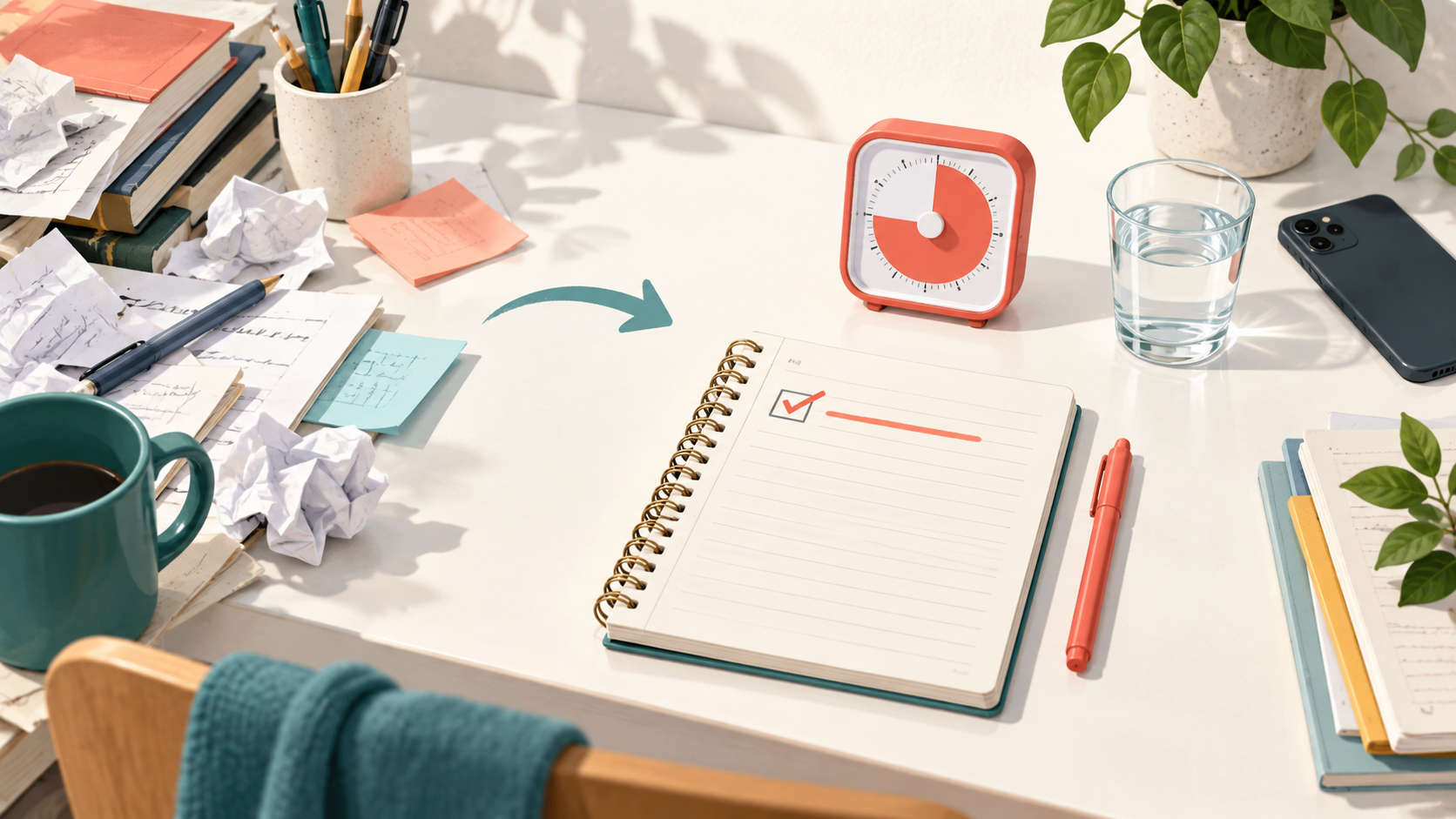
You sit down to study, open the right tab, and then everything else suddenly feels urgent. You adjust your notes, check a message, search for a better playlist, and wonder why concentration will not arrive.
When this happens, do not make “focus for three hours” the next demand. Use a smaller target: spend 20 minutes reducing friction and beginning one visible piece of work. The goal of this reset is not to finish your assignment. It is to make the next focused session easier to enter.
The 20-minute study reset
| Time | Action | Result |
|---|---|---|
| Minutes 0–2 | Clear the immediate workspace | Fewer visible decisions |
| Minutes 2–5 | Choose one concrete outcome | A finish line for the session |
| Minutes 5–15 | Do the smallest useful start | Momentum and information |
| Minutes 15–18 | Remove the next obstacle | A smoother full session |
| Minutes 18–20 | Choose a timer and begin | A clear transition into focus |
Minutes 0–2: clear only what is in reach
Do not reorganize your room. Clear the space directly around your work: close unrelated tabs, move your phone out of reach, bring water nearby, and place the materials for this subject in front of you.
Use a temporary “later” spot for anything that does not belong. A basket, a corner of the desk, or a single note can hold distractions until the session ends. The reset should not turn into a cleaning project.
Minutes 2–5: define one visible outcome
“Study biology” does not tell your attention where to land. Convert it into an action you can see and verify.
- Read pages 42–49 and write five recall questions.
- Complete problems 1–6 and mark the ones that need help.
- Draft the introduction and first topic sentence.
- Review 20 flashcards and separate the missed cards.
- Watch one lecture segment and summarize it in six lines.
If the outcome still feels heavy, make it smaller. A good session target should be meaningful but not mysterious.

Minutes 5–15: make the smallest useful start
Work for ten minutes without trying to prove that you are focused. Start at the easiest clear entry point: read the first paragraph, solve the first step, open the source, or write a rough sentence.
This short start does two things. First, it replaces prediction with evidence. You learn what the task actually requires. Second, it gives you a piece of unfinished momentum that is easier to continue than a blank page.
Use an “ugly first pass”
When perfection is slowing you down, deliberately create a rough version. Write incomplete notes, list the variables, sketch the structure, or explain the idea in plain language. You can improve material that exists.
Park unrelated thoughts
Keep a small distraction list beside you. When you remember an email, errand, or question, write a few words and return to the task. This tells your brain the thought has not been lost without requiring you to act on it now.
Minutes 15–18: remove the next obstacle
After ten minutes of real contact with the work, ask: “What is most likely to stop me next?” Fix only that obstacle.
- Download the reading so a weak connection cannot interrupt you.
- Find the formula sheet or assignment rubric.
- Write down the question you need to ask your teacher.
- Put the next document or problem on screen.
- Turn off one notification source.
If the obstacle is a missing skill or unclear instruction, do not hide it under more effort. Mark the exact point of confusion. A precise question is progress.
Minutes 18–20: choose a focus interval
Now choose a timer based on the work and your energy.
- 25 minutes: use this when starting is still difficult, your energy is low, or the task has small steps.
- 52 minutes: use this for reading, writing, or problem solving that needs time to settle.
- 90 minutes: use this when the task benefits from continuity and you have enough energy for deep work.
- Custom: choose a smaller or larger interval based on what you just learned during the reset.
Open only the materials needed for the chosen outcome, start the timer, and continue from the point you already reached.
Start a focus session in MinuFlow
If your mind still will not settle
A difficult start is information, not a character judgment. Check the basics before increasing pressure.
The task may still be too large
Reduce the target to one page, one example, one paragraph, or five minutes of review. Finishing a small unit gives you a new decision point.
Your environment may be asking too much
Move to a quieter seat, use headphones if they help you, make the screen full size, or put the phone in another room. Small environmental changes can reduce the number of choices competing with the task.
Your body may need attention
Hunger, thirst, lack of sleep, discomfort, and stress can make concentration feel much harder. A timer is useful, but it does not replace food, rest, movement, or support.
You may need another person
Studying beside someone, joining a quiet library session, or telling a friend what you will finish can add structure. Ask for specific help when instructions remain unclear.
Build a repeatable start ritual
After several sessions, keep the parts of the reset that consistently help. Your ritual might be as simple as:
- Put the phone away.
- Write one outcome.
- Open the first material.
- Start a 25-minute timer.
The ritual should be short enough to use on an ordinary day. Its job is to reduce negotiation, not add another elaborate system to maintain.
What to do after the focus session
Before your break, leave a small restart note:
- What did I finish?
- Where should I begin next?
- What question or obstacle remains?
One clear sentence can save several minutes when you return. Then take the break you planned. A reliable return matters more than stretching one session until you are depleted.
Frequently asked questions
How long should I study before taking a break?
There is no universal interval. Start with a length you can realistically enter today. Review your progress and energy after the session, then adjust.
Should I study with music?
Use the sound environment that creates the fewest interruptions for the task. Lyrics may compete with reading or writing for some people, while familiar instrumental sound or steady background noise may help others. Test it against your actual work.
What should I do when my phone is the main distraction?
Increase the physical distance. Put it in a bag, drawer, or another room, and allow important contacts to bypass Do Not Disturb if necessary. Making distraction slightly less convenient can be more reliable than repeatedly resisting it.
What if I keep having serious trouble concentrating?
Ongoing concentration problems can have many causes. If they are affecting school, work, relationships, or daily life, consider speaking with a qualified health professional or your school’s support services.